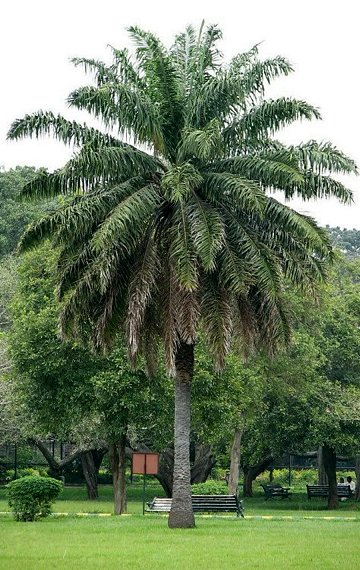
|
|
African Oil Palm
(Elaeis guineensis)
|
African Oil Palm - Elaeis guineensis
Elaeis guineensis is a species of palm commonly called oil palm but also sometimes African oil palm or macaw-fat.
The oil palm is a multi-purpose tree of major importance in Africa, where it supplies food, medicines and many other products to the local population. Increasingly coming under cultivation, this species is rapidly becoming one of the world's most cultivated plants, being grown especially for its oil-bearing seeds and fruits. The tree is sometimes planted as a garden ornamental and along avenues.
It is the principal source of palm oil. Oil palms can produce much more oil per unit of land area than most other oil-producing plants (about nine times more than soy and 4.5 times more than rapeseed).
It is native to west and southwest Africa, specifically the area between Angola and The Gambia; the species name, guineensis, refers to the name for the area called Guinea, and not the modern country Guinea now bearing that name. The species is also now naturalised in Madagascar, Sri Lanka, Malaysia, Indonesia, Central America, Cambodia, the West Indies, and several islands in the Indian and Pacific Oceans. The closely related American oil palm E. oleifera and a more distantly related palm, Attalea maripa, are also used to produce palm oil.
E. guineensis was domesticated in West Africa along the south-facing Atlantic coast. The first Western person to describe it and bring back seeds was the French naturalist Michel Adanson.
E. guineensis is monocotyledonous. Mature palms are single-stemmed and grow to 20 - 30
metres tall. The erect, cylindrical, unbranched stem can be 22 - 75cm in diameter, it is topped by a crown of about 40 - 60 live dark green pinnate leaves that can be 3- 8 metres long, and a skirt of dead leaves. A young palm produces about 30 leaves a year. Established palms over 10 years produce about 20 leaves a year. The flowers are produced in dense clusters; each individual flower is small, with three sepals and three petals.
The palm fruit takes 5–6 months to develop from pollination to maturity. It is reddish, about the size of a large plum, and grows in large bunches. Each fruit is made up of an oily, fleshy outer layer (the pericarp), with a single seed (the palm kernel), also rich in oil. When ripe, each bunch of fruit weighs between 5 and 30 kg (11 and 66 lb) depending on the age of the palm tree.
Two types of oil are obtained from the plant. Palm oil is obtained from the fruit whilst palm kernel oil is obtained from the seed. They are obtained in a volume ratio of approximately 9 : 1.
Palm oil has a wide range of uses, including making margarine, vegetable ghee, bakery fats, ice cream and as a cooking oil. Palm oil is popular in West Africa and Malaysia for cooking and is now imported by India to meet local shortages in edible oil, being cheaper than many other vegetable oils. In West Africa, the unrefine red palm oil is an essential part of the diet and is often added directly to bring richness to soups and sauces. Addition of oil to cereal preparations greatly increases their calorific density, which is particularly advantageous for young children. Palm oil is also used as frying oil in the preparation of snacks such as bean cakes and fried plantain. Its 10% linoleic acid content makes it an excellent source of carotene. This is important in reducing incidence of vitamin A deficiency and the occurrence of nutritional blindness.
Palm kernel oil is similar in composition and properties to coconut oil. It also has a wide range of uses, including making margarine, ice cream, confectioneries and as a cooking oil, where it is sometimes combined with coconut oil.
The boiled and pounded nuts yield palm nut butter, a thick red liquid popular in Ghana and Liberia for making palm butter soup and other dishes.
The plant also provides heart-of-palm, where the soft portion of the apical bud is eaten as a vegetable. Since the tree is single-stemmed, and palm trees are generally unable to produce side branches, harvesting this bud leads to the death of the tree.
Palm wine is commonly produced in West Africa by tapping the unopened male inflorescences, or the stem just below the apex of felled oil palms, and fermenting the sap.
Traditional medicinal uses in Africa are numerous.
Preparations made from the palm heart are used to treat gonorrhoea, menorrhagia, and perinatal abdominal pain, and are considered laxative, anti-emetic and diuretic.
The leaf sap is used in preparations used to treat skin affections. The roots as analgesic.
The oil from the pulp is emollient and is used as an excipient for herbal ointments. It is used to treat suppurations, whitlows and swellings of the legs caused by erysipelas and infestations by Filaria.
Two types of oil are obtained from the plant:
Palm oil is obtained from the fruit. About 10% of all palm oil, the inferior grades in particular and also refining residues, is used to manufacture soaps, detergents, candles, resins, lubricating greases, cosmetics, glycerol and fatty acids. Palm oil is employed in the steel industry (for sheet-steel manufacturing and tin plating, where it protects the iron before the tin is applied) and epoxidized palm oil is a plasticizer and stabilizer in PVC plastics.
Palm kernel oil, obtained from the seed, is a non-drying oil. It is used as an alternative to coconut oil in making high quality soaps, as a lubricant etc. It is a source of short-chain and medium-chain fatty acids. These acids are chemical intermediates in the production of fatty alcohols, esters, amines, amides and more sophisticated chemicals, which are components of many products such as surface-active agents, plastics, lubricants and cosmetics.
Both oils also have a wide range of other uses, including making detergents, shampoos, cosmetics, lubricating oil additives and fluxes.
It is technically possible to produce from palm oil either carbohydrates for conversion to alcohol or a methanolizable oil as a diesel substitute. In Togo, the pressed fruits are dried and fashioned into cakes for cooking fuel.
The empty bunches, fibre and also the effluent (0.5 t sludge for each t of milled fruit bunches) from the oil mills can be converted into products such as organic fertilizers.
Palm fronds are useful for thatch. The entire palm fronds of this species are less suitable for thatching than those of the coconut palm, because of irregular leaflet insertion. However, the leaflets are often woven into baskets and mats; the leaflet midribs are made into brooms and the rachises used for fencing.
Young leaflets produce a fine strong fibre, used for making fishing lines, rsopes, strings and strainers. Obtained from the inner leaflets of the plant, it is said to be almost as fine and tenacious as human hair and to possess great strength. The leaflets have to be harvested just after they have opened and before hardening. Yields of fibre are quite small from each leaflet and, although the fibre is of excellent quality it is very time consuming to obtain.
The seed shells are polished and carved into ornamental rings and beads.
Palm trunks, available at replanting, provide excellent material for paper and board production, but this has not yet attracted much commercial interest.
The seed shells are much appreciated by local blacksmiths as a high calorific fuel for furnaces.
Source:
https://en.wikipedia.org/wiki/Elaeis_guineensis
https://tropical.theferns.info/viewtropical.php?id=Elaeis+guineensis