|
|
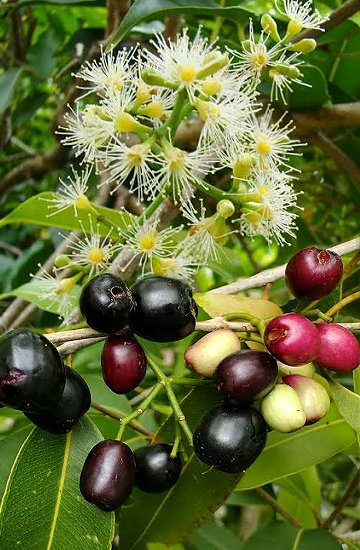
Java plum (Syzygium cumini).
Flowers and fruits.
|
Java plum - Syzygium cumini
Syzygium cumini, also known as Java plum, Malabar plum, jambolan, black plum, jamun, jambul, is an evergreen tropical tree in the flowering plant family Myrtaceae, and favored for its fruit, timber, and ornamental value. It is native to the Indian subcontinent and Southeast Asia. It can reach heights of up to 30 m (100 ft) and can live more than 100 years. A rapidly growing plant, it is considered an invasive species in many world regions.
Syzygium cumini has been introduced to areas including islands of the Pacific and Indian Oceans, Australia, Hong Kong and Singapore.
The tree was introduced to Florida and is grown in tropical and subtropical regions worldwide. Its fruits are eaten by various native birds and small mammals, such as jackals, civets, and fruit bats.
Syzygium cumini is a fast-growing, attractive, compact, evergreen shrub or tree with a dense, frondose crown. It usually grows 10 - 15 metres tall, but can reach a height of up to 35 metres. The straight bole is short, stout, and low branched, usually around 40 - 100cm in diameter.
Its dense foliage provides shade and is grown for its ornamental value. At the base of the tree, the bark is rough and dark grey, becoming lighter grey and smoother higher up. The wood is water resistant after being kiln-dried. Because of this, it is used in railway sleepers and to install motors in wells. It is sometimes used to make cheap furniture and village dwellings, though it is relatively hard for carpentry.
The aromatic leaves are pinkish when young, changing to a leathery, glossy dark green with a yellow midrib as they mature. The leaves are used as food for livestock, as they have good nutritional value.
Syzygium cumini trees start flowering from March to April. The flowers are fragrant and small, about 5 mm (0.2 in) in diameter. The fruits develop by May or June and resemble large berries; the fruit of Syzygium species is described as "drupaceous". The fruit is oblong, ovoid. Unripe fruit looks green. As it matures, its color changes to pink, then to shining crimson red and finally to black color. A variant of the tree produces white-coloured fruit. The fruit has a combination of sweet, mildly sour, and astringent flavour and tends to colour the tongue purple.
Jambolan is a very ancient fruit crop, cultivated for over 2,500 years in India, where it is venerated by Buddhists and Hindus. It is considered to be sacred to Krishna and is often planted near temples. The tree is widely cultivated in the tropics and subtropics for its edible fruit. The fruits and the seeds (for medicinal purposes) are sold in local markets. It is also planted for shade, ornament, windbreaks, and hedges.
Jambolan fruits have a sweet or slightly acidic flavor, are eaten raw, and may be made into sauces or jam. Fruits may be made into juice, jelly, sorbet, syrup (e.g., kala khatta), or fruit salad. The fruit is juicy, almost odourless, with a pleasant, slightly bitter, astringent taste. The purple, olive-shaped fruit is somewhat astringent. The astringency can be removed by soaking the fruit in salt water prior to cooking it. The fruit tends to be of variable quality, at best it is pleasantly and mildly acidic.
A coffee-like beverage is made from the dried and ground up seeds.
Both the seeds and the fruit are diuretic and have important carminative and astringent properties. The seeds also reduce blood sugar levels and are useful in the treatment of diabetes.
The seeds and bark are well known in the Far East for the treatment of dysentery and in the control of hyperglycaemia and glycosuria in diabetic patients.
The juice of the bark is considered good for treating wounds and enlargement of the spleen.
The bark is astringent. An infusion is used to treat irregular menstruation, diarrhoea, dysentery, children's thrush etc.
The bark is used as a gargle to strengthen gums, treat mouth ulcers etc.
The ripe fruit is astringent and is used as an effective treatment for diabetes. Fruits are used as a relief for colic and to treat diarrhoea.
An infusion of the leaves is used in the treatment of diabetes and diarrhoea.
The wood yields a sulphate pulp that has medicinal uses.
The roots are sometimes used as a treatment for epilepsy.
The bark contains 13 - 19% tannins. It has served in tanning and also yields a brown dye that has been used in colouring and preserving fishnets.
The branches are used to whiten the teeth.
The reddish-grey or reddish-brown heartwood is fine grained and is utilized in exterior joinery and carpentry.
Source:
https://en.wikipedia.org/wiki/Syzygium_cumini
https://tropical.theferns.info/viewtropical.php?id=Syzygium+cumini