|
|
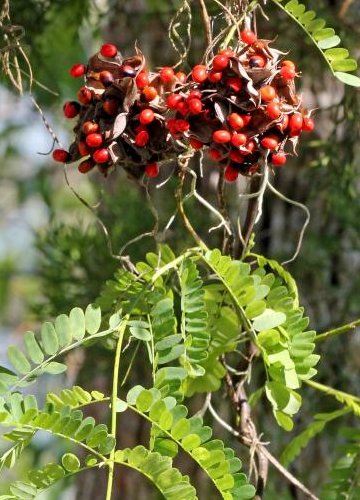
Rosary pea (Abrus precatorius).
Leaves and fruits.
|
Rosary pea - Abrus precatorius
Abrus precatorius, commonly known as jequirity bean or rosary pea, is a herbaceous flowering plant in the bean family Fabaceae. It is a slender, perennial climber with long, pinnate-leafleted leaves that twines around trees, shrubs, and hedges.
The plant is best known for its seeds, which are used as beads and in percussion instruments, and which are toxic because of the presence of abrin. Ingestion of a single seed, well chewed, can be fatal to both adults and children. The plant is native to Asia and Australia. It has a tendency to become weedy and invasive where it has been introduced.
Abrus precatorius is a severely invasive plant in warm temperate to tropical regions, so much so that it has become effectively pantropical in distribution. It had been widely introduced by humans, and the brightly coloured and hard-shelled seeds had been spread by birds. By the end of the twentieth century, it had been proclaimed as an invasive weed in many regions including some in Belize, Caribbean Islands, Hawaii, Polynesia and parts of the mainland United States.
Abrus precatorius is a perennial, deciduous, woody, prickly twining or climbing
herb producing numerous stems from the base that can be up to 6 metres, occasionally 9 metres long. These stems scramble over the ground, twining into other nearby plants for support.
The deep tap root of this perennial aids in
resprouting after fire or attempts at eradication. Stem cylindrical, wrinkled, bark smooth-textured, brown.
The even-pinnately compound leaves have eight to 20
pairs of oblong 1- to 1.3-cm-long leaflets. Leaflets
are turgid, oblong, obtuse, truncate at both ends, appressed hairy. They are alternate and glabrous with many paripinnate leaflets arranged in pairs.
The inflorescence is a raceme 1 to 3 cm long. The
pea-like flowers are pale purple to lavenderpink or white (rarely). small, in short stalked dense clusters at leaf axils.
Fruit a short, oblong pod, 1- to 1.5-cm-wide,
with a sharp beak at the tip, splitting before falling to reveal 3-8 shiny hard seeds, 6-7 mm that are scarlet red with a black spot. These attractive seeds (used to make bead necklaces and other jewelry) are extremely poisonous.
Abrin is a plant toxin obtained from Abrus precatorius seeds. Symptoms of poisoning include nausea, vomiting, convulsions, liver failure, and death, usually after several days.
This plant is also poisonous to horses.
The seeds contain toxic substances, but these are easily broken down by heat. The thoroughly-cooked seeds are sometimes eaten in times of shortage, though they remain hard and are not very digestible. Temperatures in excess of 65°c are said to break down the toxic principle.
The seeds contain a number of medically active ingredients, including the extremely toxic substance abrin, indole alkaloids and anthocyanins. They are extremely toxic but are used medicinally as an abortifacient, contraceptive, emetic and irritant. The seeds are also antiperiodic, bitter, aphrodisiac, diaphoretic, emetic, expectorant and purgative. They have played an important role in the treatment of conjuctivitis in various parts of the world.
The seeds, although very toxic. are applied externally as an antiseptic and anti-inflammatory poultice to accelerate the bursting of boils and to cure mastitis and galactophoritis. They are also used externally in the treatment of sciatica, hair loss, skin disease, leprosy, nervous debility and paralysis.
The seeds are dried and then ground into a paste when required.
The leaves and roots contain glycyrrhizin and minute amounts of the toxin abrin. They have soothing properties and are expectorant, antiinflammatory and antiallergic. They are used internally to treat sore throats and a range of chest conditions including asthma, bronchitis and dry coughs.
The roots have been used to treat digestive disorders. A paste of the roots is applied to boils.
The stems and leaves, combined with the leaves, stems and roots of Zea mays, are made into a tisane that is used to remedy mild inflammations of the urinary tract, diarrhoea, aphthae and hoarseness. The leaves are boiled with the leaves of Tamarindus indica, Annona muricata and Lantana camara to make a syrup used to treat chest colds.
A paste of the leaves is used to treat leukoderma, swellings, boils, rheumatism etc.
The leaves can be dried for later use.
The stem bark is emollient. A decoction is used as a treatment for stomach-ache, thrush, colds, coughs, sore throat and asthma. An extract of the bark is used as a treatment for cancer treatment.
The seeds of Abrus precatorius are much valued in native jewelry for their bright coloration.
Seeds are used as beads and to make necklaces. Popular for ornamental use and for rosaries, the necklace is traditionally given to children to wear as protection against disease. Most beans are black and red, reminiscent of a ladybug, though other colors exist. Jewelry-making with jequirity seeds is rumored to be somewhat hazardous. There are persistent reports that the workers who pierce the seeds in order to thread them can suffer poisoning or even death from a pinprick, but there seems to be little evidence.
In Trinidad in the West Indies the brightly colored seeds are strung into bracelets and worn around the wrist or ankle to ward off jumbies or evil spirits and "mal-yeux"—the evil eye. The Tamils use Abrus seeds of different colors. The red variety with black eye is the most common, but there are black, white and green varieties as well.
The seeds of Abrus precatorius are very consistent in weight, even under different moisture conditions due to the water-impermeable seed-coat. (individual seeds weigh about 1.75g or 1 carat) and are used traditionally in India to weigh gemstones. Formerly Indians used these seeds to weigh gold using a measure called a Ratti, where 8 Ratti = 1 Masha; 12 Masha = 1 Tola (11.6 Grams).
Source:
https://en.wikipedia.org/wiki/Abrus_precatorius
https://tropical.theferns.info/viewtropical.php?id=abrus+precatorius
https://www.fdacs.gov/Agriculture-Industry/Pests-and-Diseases/
Plant-Pests-and-Diseases/Noxious-Weeds/Abrus-precatorius-Rosary-Pea