|
|
Bee Bee tree
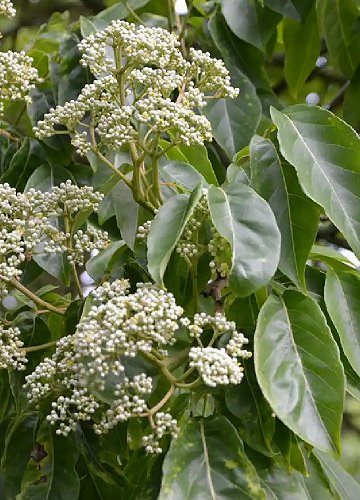
(Tetradium daniellii). Leaves and flowers.
|
Bee Bee tree - Tetradium daniellii
Tetradium daniellii, commonly known as the Bee-Bee tree or Bee tree or Korean
evodia, is a deciduous tree native to China and Korea. Famous for its exceptional honey-bearing flowering that yield copious amounts of nectar, it has a rich history tied to early botanists, global arboretums, and beekeeping.
The species originates from the temperate and tropical zones of East Asia. It was first documented and collected by British surgeon and botanist William Freeman Daniell during the British forces' deployment to Tientsin, China, between 1860 and 1862.
It was formally described and named Euodia daniellii by the British botanist John Joseph Bennett in 1862. The tree was later reclassified into the genus Tetradium.
The tree was first introduced to Western cultivation in the early 20th century. The Arnold Arboretum at Harvard University received the first seeds from Korea in 1905, collected by renowned dendrologist John Jack.
Shortly after its arrival in the United States, seeds were brought to the Royal Botanic Gardens, Kew, in 1907.
Tetradium daniellii is native to Korea and southwestern China. It is a deciduous tree with a rounded, spreading, umbrella-shaped habit. It typically grows to
8-10 ίcm (less frequently to 15 cm) tall and as wide. They are attractive trees with deciduous glossy pinnate leaves. Tetradium daniellii (syn. T. hupehensis) develops a smooth gray bark that resembles that of a beech tree.
Opposite, pinnately compound leaves (to 45 cm long), each with 7-11 ovate glossy dark green leaflets
(5-12 cm long). The leaves resemble the foliage of an ash tree and are a glossy dark green in summer. In fall there is little color change and leaves tend to drop green to yellow-green.
Fall color is generally absent, with the leaves typically dropping when green or yellowish-green.
The species is hermaphrodite (has both male and female organs). The tree is covered in late July and August with masses of large flat white to gray cluster of small white
flowers, reminiscent of elderberry blooms, (sometimes tinged yellow or pink), particularly valued when few other tree-size plants are flowering. The flowers are fragrant and attract large numbers of bees and is sought after by beekeepers as a source of late summer honey.
Flowers give way to reddish-purple seed pods that is present from late August through
November that when fully ripe open to expose black seeds. Pods remain on the tree from late August to November.
Seeds are decorative and favored by birds.
An edible oil is obtained from the fruit. Used for cooking. The oil from the fruit is used in making a hair
oil.
In Apiculture the tree is highly valued by beekeepers.
Originally planted strictly as an ornamental or botanical specimen, the tree has adapted well to Western climates.
Still little known in private gardens, it is highly appreciated in parks and orchards for its harmonious shape, late flowering, and ecological interest.
Source:
https://en.wikipedia.org/wiki/Tetradium_daniellii
https://www.missouribotanicalgarden.org/plantfinder/
PlantFinderDetails.aspx?taxonid=291853
https://www.botanic.cam.ac.uk/the-garden/plant-list/tetradium-daniellii/
https://arboretum.harvard.edu/stories/bee-bee-tree/