|
|
Silk floss tree
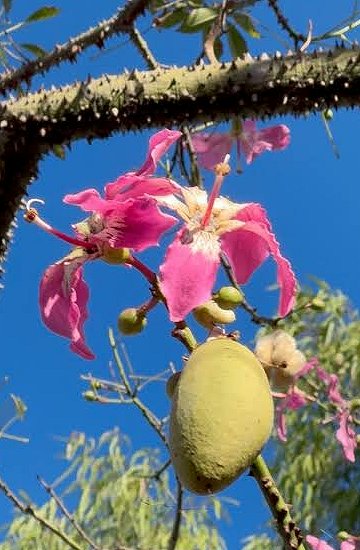
(Ceiba speciosa). Flowers and fruit.
|
Silk floss tree - Ceiba speciosa
Ceiba speciosa, the Silk floss tree (formerly Chorisia speciosa), is a species of deciduous tree that is native to the tropical and subtropical forests of South America. It belongs to the same subfamily as the baobab; the species Bombax ceiba; and other kapok trees.
The plant is harvested from the wild mainly for its seed floss, which is used as a stuffing material. It is often grown as an ornamental, being valued especially for its spectacular flowering display.
This tree was recently removed by some experts from the Bombacaceae family to the Malvaceae family and renamed
from Chorisia speciosa to Ceiba speciosa. Hibiscus is in the mallow family (silk floss tree and hibiscus have similar flowers) and Kapok tree is in the Ceiba genus (silk floss tree and kapok both have silky floss in seed pods). RHS still recognizes Chorisia as the genus name.
Genus name honors botanical artist Ludwig (Louis) Choris (1795-1828). Specific epithet
(speciosa) means showy.
The natural range of the floss silk tree is in the northeast of Argentina, east of Bolivia, Paraguay, Uruguay, and southern Brazil. It is resistant to drought and moderate cold.
It is a conical fast-growing deciduous tree with a dense, wide-spreading
canopy and somewhat irregular branching. It grows fast in spurts when water is abundant, and sometimes reaches more than 25 metres
in height. Its trunk is bottle-shaped, generally bulging in its lower third, measuring up to 2 metres
in girth and 80 - 120cm in diameter. The trunk is studded with large, sharp, conical prickles that deter wild animals from climbing the trees. In younger trees, the trunk is green due to its high chlorophyll content, which makes it capable of performing photosynthesis when leaves are absent; with age it turns to gray.
The branches tend to be horizontal and also are covered with prickles. The branches hold a palmately compound leaf. Each palmate, compound, light green leaf has 5-7 serrate, lanceolate leaflets reaching up to (12.5 cm long. Leaves typically drop in fall before this tree blooms.
The flowers are quite showy, featuring pink to rose-purple petals with creamy white to yellowish-white
throats. They measure 10 to 15 centimetres in diameter and their shape is superficially similar to hibiscus flowers. Their nectar is known to attract insect pollinators and hummingbirds. C. speciosa flowers are in bloom between February and May (in its native Southern Hemisphere), but it may bloom at other times of the year, even as late as November in Florida. The flowers of the related C. chodatii are similar in form and size, but their color goes from creamy white centers to yellow tips. As a deciduous tree, it is completely bare of leaves and flowers during the winter months, especially when growing outside of its native South American habitat.
Flowers are followed by fruits. The fruits are lignous ovoid pear-shaped capsules, 20 centimetres long, filled with seed embedded in silky white floss (hence the common name of
Silk floss tree).
Capsules split open in spring when ripe releasing the seeds into the wind. This fruit rarely sets on trees grown outside of tropical areas.
The 'cotton' (seed floss) inside the capsules, although not so good quality as that of the kapok tree, has been used as stuffing material in pillows.
This plant yields a fibre of which textures are made which are so much like silk in their lustre, fineness, and pliability as to be scarcely distinguished from it.
From the seeds, it is possible to obtain vegetable oil.
The wood can be used to make canoes, troughs, wooden bowls, clogs, boxes etc. It can also be used as a source of
cellulose, as wood pulp, and to make paper.
The bark has been used to make ropes. From the seeds, it is possible to obtain vegetable oil (both edible and industrially useful).
Ceiba speciosa is cultivated mostly for ornamental purposes. Outside of private gardens around the world, it is often planted along urban streets in subtropical areas such as in Spain, South Africa, Australia, northern New Zealand, and the southern USA, although its prickled trunks and limbs require establishing safety buffer zones around the tree in order to protect people and domesticated
animals from its prickles.
Ceiba speciosa is added to some versions of the hallucinogenic drink Ayahuasca.
Source:
https://en.wikipedia.org/wiki/Ceiba_speciosa
https://tropical.theferns.info/viewtropical.php?id=Ceiba%20speciosa
https://plantfinder.mobot.org/
PlantFinderDetails.aspx?taxonid=458008&isprofile=0&hf=5